

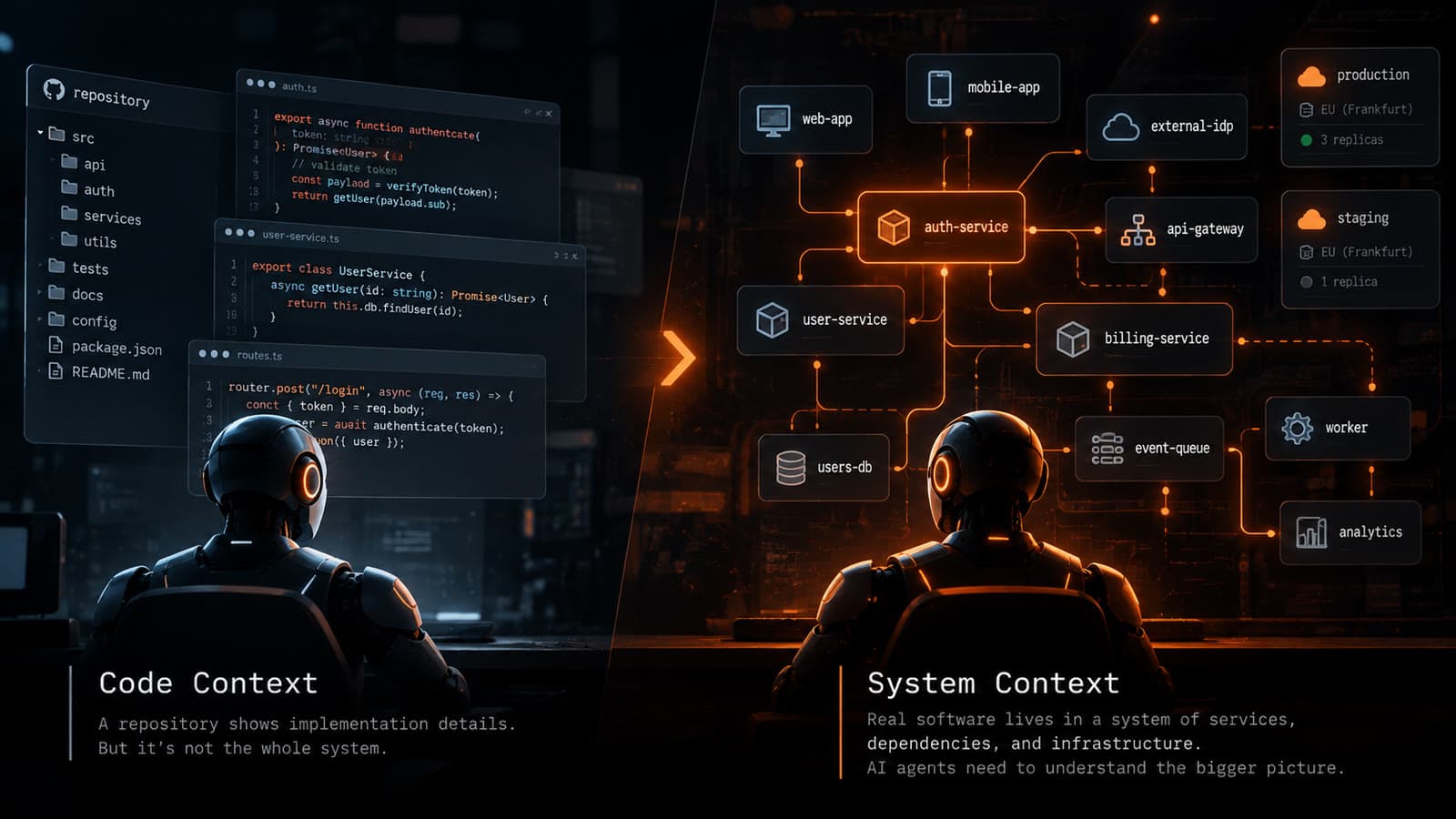
AI coding agents are getting remarkably good at writing software.
They can inspect repositories, generate features, refactor existing code, write tests, and sometimes complete development tasks with surprisingly little human intervention.
For many developers, the question is no longer whether AI can write useful code.
It's whether AI understands enough about the system to know what code should be written in the first place.
And those are two very different problems.
A repository is not the whole system
Imagine asking an AI coding agent to implement a new authentication feature.
The agent examines the repository, identifies the relevant files, understands the existing authentication logic, and produces a working implementation.
The tests pass. The code looks reasonable.
But what if authentication also depends on an external identity provider, an API gateway, a separate user service, and environment-specific configurations?
What if another application relies on the same authentication flow?
Or an older service still uses an endpoint that the agent has just modified?
The agent might understand the code perfectly well while missing important parts of the architecture surrounding it.
This isn't necessarily a failure of code generation.
It's a problem of incomplete context.
Context windows are not architectural understanding
Modern AI models can process increasingly large amounts of information.
That helps. But a larger context window doesn't automatically translate into a more accurate understanding of a software system.
Even if an agent could read every file in a repository, several important questions might remain unanswered:
- Which services are actually deployed?
- Which databases are connected to which applications?
- What depends on a particular API endpoint?
- Which background workers are still running?
- Which infrastructure resources exist outside the repository?
- How do staging and production differ?
- What changed in the system since the last deployment?
Some answers might be found in configuration files. Others might require cloud APIs, runtime telemetry, deployment metadata, or access to entirely different repositories.
And some relationships may not be documented anywhere.
More code in the context window doesn't necessarily mean more system context.
The challenge is not simply how much information an agent can process.
It's whether the right information is available, accurate, and relevant to the task.
Software architecture is distributed across tools
A modern application rarely lives in one place.
Its architecture is scattered across repositories, deployment platforms, databases, cloud providers, CI/CD pipelines, APIs, and third-party services.
Developers often reconstruct this architecture mentally.
They remember that one service communicates with another, that a database is shared, or that a deployment depends on an environment variable configured somewhere outside the codebase.
This knowledge is incredibly useful.
It's also fragile.
When a developer leaves a project, changes teams, or simply forgets an implementation detail, part of that architectural understanding can disappear.
AI coding agents face a similar problem, but at a different scale.
They may have access to source code without having access to the operational knowledge that gives the code meaning.
As a result, an agent can make a locally reasonable change that has unexpected consequences elsewhere.
From code context to system context
What would it take for an AI coding agent to understand more than a repository?
It would need some representation of the broader software environment.
Not necessarily a massive document containing every technical detail.
A structured view of the system could be more useful.
For example, imagine an agent being able to determine that:
- A particular repository builds two deployed services.
- One service exposes an API consumed by three applications.
- Another service processes events from a message queue.
- Both depend on the same production database.
- A scheduled worker still uses an older API version.
- A proposed change would affect multiple downstream components.
That information changes how an agent approaches a task.
Instead of asking only, "Which files should I modify?", it can begin asking, "Which parts of the system could this change affect?"
This is the difference between understanding an isolated implementation and reasoning about its place in a larger architecture.
The importance of relationships
Software architecture is fundamentally about relationships.
A repository contains code, but a system consists of components that interact.
Services call APIs. Workers consume messages. Applications read and write data. Deployment pipelines produce running workloads.
These relationships can be represented as a graph.
Components become nodes. Dependencies and interactions become edges.
A graph-based representation doesn't automatically solve architectural reasoning.
The relationships still need to be discovered, validated, and kept current.
But it provides a useful foundation for questions that are difficult to answer through source-code inspection alone.
Which components depend on this service?
What could break if this database schema changes?
Which systems might be affected by removing an endpoint?
Where does a particular data flow originate?
These are architectural questions, not merely coding questions.
Architecture changes faster than documentation
There's another complication.
Even a highly detailed architecture map becomes less useful when it stops reflecting reality.
New services are deployed. APIs evolve. Databases are migrated. Dependencies change. Temporary infrastructure becomes permanent.
A static diagram may describe how a system looked six months ago.
An AI agent needs to understand how it looks now.
This suggests that architectural context should not be treated as a document written once and occasionally updated.
Ideally, it should be derived from the actual development and infrastructure environment, refreshed as the system changes, and accompanied by information about where each relationship was discovered.
Some connections can be verified directly. Others can only be inferred.
Distinguishing between those two matters, especially when an AI agent uses architectural information to make decisions.
What if architecture became part of the agent's context?
Consider a different development workflow.
A coding agent receives a task: modify an API endpoint.
Before editing code, it queries a current representation of the software architecture.
It identifies the service that owns the endpoint, its downstream consumers, related databases, deployment environments, and potentially affected components.
It then retrieves the relevant source files and performs the change with that broader context in mind.
After implementation, the agent could compare the updated code and configuration against the known architecture to identify relationships that may have changed.
This wouldn't eliminate mistakes.
Nor would it replace testing, code review, or runtime monitoring.
But it could reduce the gap between what an agent knows about the code and what it needs to know about the system.
And importantly, the same architectural context could serve human developers.
A new team member could explore dependencies without reconstructing everything manually. A developer investigating an incident could identify related services. An engineering team could compare intended and observed architecture.
The underlying challenge is the same: making complex software systems easier to understand.
The next bottleneck might not be code generation
As AI coding agents improve, generating code may become an increasingly small part of the overall engineering challenge.
The harder questions remain:
Is this the right change?
What does it depend on?
What else could it affect?
Does the implementation match the actual deployed environment?
And how confident are we that our understanding of the system is correct?
Answering these questions requires more than a larger context window or better code completion.
It requires reliable access to the structure, dependencies, and changing state of the software environment.
The next major improvement in AI-assisted development might come not from teaching agents to write more code, but from giving them a better understanding of the systems they're changing.