

The change looked simple.
Imagine a developer working on a growing SaaS application.
The system has a web application, an API gateway, an authentication service, a billing service, a PostgreSQL database, and several background workers.
The developer wants to update the authentication flow. Perhaps they're introducing a new token validation mechanism or modifying how user sessions are handled.
An AI coding agent can help implement the change quickly.
It finds the relevant functions, updates the authentication logic, modifies a few tests, and prepares a pull request.
The code looks reasonable.
But there's a question that the pull request alone may not answer:
What else depends on the authentication service?
Does the API gateway validate tokens independently? Does the billing service depend on authentication claims? Will background workers continue to receive valid credentials? Are there infrastructure configurations outside the repository that could be affected?
A change can be locally correct and still introduce problems elsewhere in the system.
And as AI makes individual code changes faster, understanding their wider consequences becomes increasingly important.
The growing gap between code context and system context
Software development tools have become remarkably good at navigating source code.
But a production software system is more than its repositories.
It includes deployed services, databases, network connections, infrastructure configurations, authentication boundaries, external integrations, and dependencies that may not be fully documented in one place.
Consider a typical service relationship:
web-app → api-gateway → auth-service
That looks straightforward.
But the same authentication service might also interact with a session store, issue credentials consumed by background workers, and provide identity information used by billing.
Some relationships are visible in application code. Others are defined through infrastructure configuration, environment variables, service discovery, or deployment settings.
The difficulty isn't necessarily changing the authentication service.
It's knowing whether you've understood the entire system surrounding it.
This challenge becomes especially relevant when coding agents participate in development.
Google's 2025 DORA research found that AI amplifies the strengths and weaknesses of existing engineering practices. Faster code generation doesn't automatically eliminate problems in the underlying development workflow.
The Stack Overflow 2025 Developer Survey also found that 66% of respondents experienced frustration with AI-generated solutions that were almost correct, but not quite.
These findings point toward a broader engineering principle: improving the speed of implementation is only part of improving software development.
We also need better ways to understand what we're changing.
From reading files to understanding relationships
Traditionally, developers investigate architectural dependencies through a combination of repository searches, documentation, cloud dashboards, configuration files, and conversations with teammates.
For a small application, that may be manageable.
For a distributed system, the investigation can become a task of its own.
An alternative is to begin with a discovered representation of the software architecture and ask a more focused question:
“What components could be affected if we change our authentication service?”
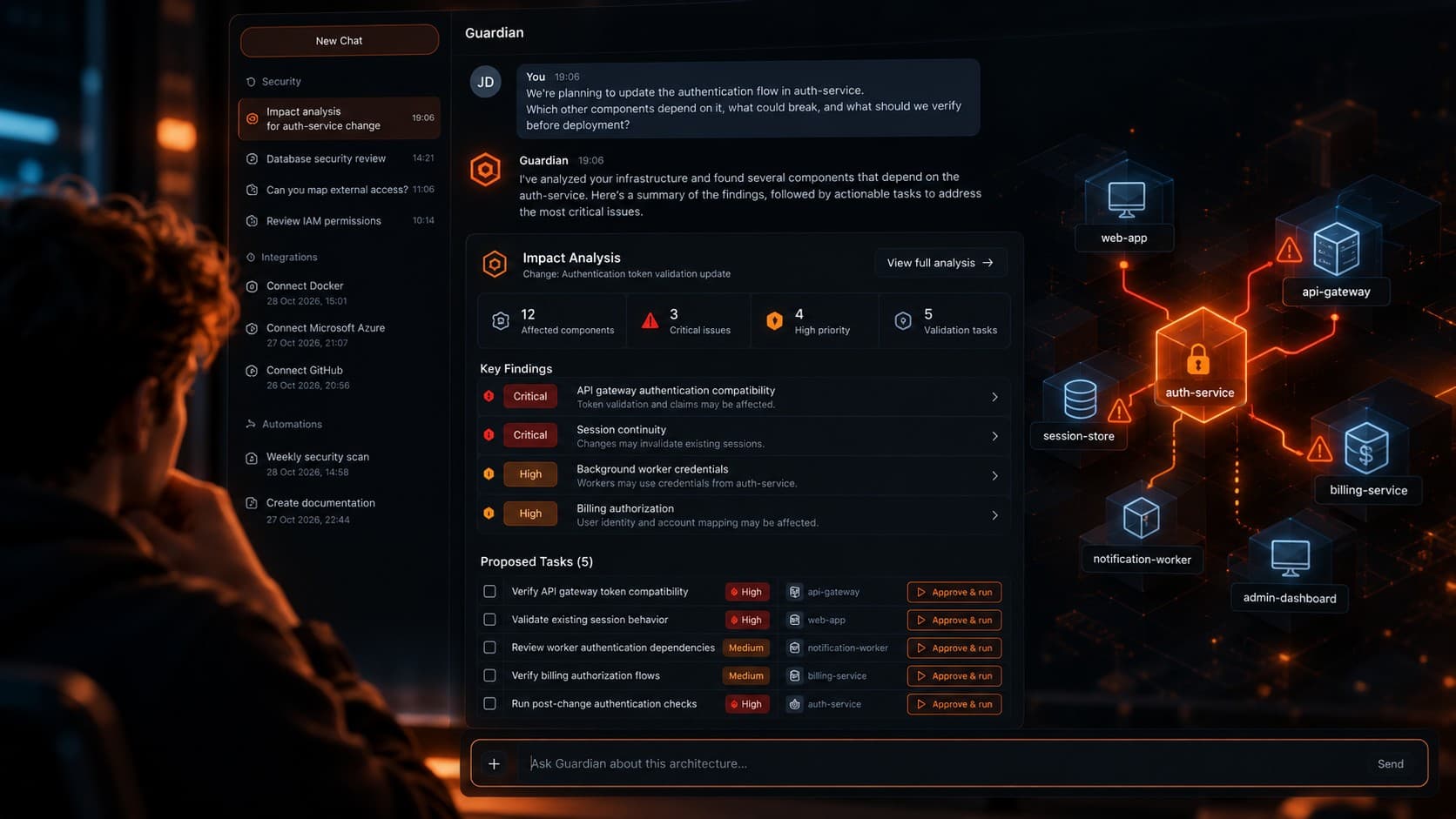
To illustrate what this workflow can look like, consider a representative architecture analysis in SPECTRALE Guardian.
The example below uses a fictional SaaS infrastructure. Its components, findings, and proposed actions are illustrative rather than results from a verified production scan.
The output: An architecture impact analysis
User → Guardian
We're planning to update the authentication flow in
auth-service. Which other components depend on it, what could break, and what should we verify before deployment?
Guardian → Architecture Impact Report
Change Impact Overview
Target component: auth-service
Proposed change: Authentication token validation update
Analysis scope: Connected architecture and discovered service relationships
| Metric | Result |
|---|---|
| Directly connected components | 4 |
| Additional potentially affected components | 2 |
| High-priority review items | 2 |
| Medium-priority review items | 2 |
| Suggested validation tasks | 5 |
| Deployment readiness | Review required |
Illustrative demo output — not a live production assessment.
1. Identified dependencies
| Component | Relationship | Potential impact |
|---|---|---|
api-gateway | Forwards authenticated API requests | Token validation compatibility |
web-app | Initiates user authentication | Login and session continuity |
session-store | Maintains session state | Session invalidation or expiration |
billing-service | Consumes authenticated user identity | Authorization and account mapping |
notification-worker | Processes user-related events | Credential propagation |
admin-dashboard | Uses privileged authentication flows | Administrative access continuity |
These relationships provide a starting point for reviewing the proposed change.
A discovered connection alone does not prove that a component will fail. It identifies where additional verification may be necessary.
2. Priority findings
HIGH — API gateway authentication compatibility
The API gateway may rely on token claims or validation behavior that will change with the new authentication implementation.
Recommended action: Verify token formats, signing keys, claim expectations, and validation behavior before deployment.
HIGH — Session continuity
Changes to authentication handling may affect existing sessions, particularly if token formats, expiration policies, or session identifiers are modified.
Recommended action: Test session migration, expiration, and reauthentication behavior.
MEDIUM — Background worker credentials
Background processes may use credentials issued or validated by the authentication service.
Recommended action: Identify affected service credentials and verify that scheduled and asynchronous operations remain functional.
MEDIUM — Billing authorization
The billing service may depend on user identity information supplied through authenticated requests.
Recommended action: Confirm that account ownership and authorization checks remain consistent.
3. Proposed validation tasks
Guardian prepares a set of reviewable tasks:
| Task | Priority | Status |
|---|---|---|
| Verify API gateway token compatibility | High | Awaiting approval |
| Validate existing session behavior | High | Awaiting approval |
| Review worker authentication dependencies | Medium | Awaiting approval |
| Verify billing authorization flows | Medium | Awaiting approval |
| Run post-change authentication checks | High | Awaiting approval |
5 tasks prepared · 0 approved · 0 executed
The proposed workflow separates architectural analysis from implementation.
Developers review the findings, inspect the supporting evidence, and decide which actions should proceed.
Where agent execution is supported and authorized, approved changes can be handed off to a connected coding agent. Verification and deployment remain subject to the project's configured controls.
What makes this output useful?
The interesting part isn't simply that an AI assistant produced a report.
It's the structure of the information.
Instead of returning a general explanation of how authentication works, the analysis connects a specific proposed change to components in a software architecture.
That creates three practical advantages.
1. Dependencies become explicit
Developers can review the relationships surrounding a component rather than relying entirely on memory or scattered documentation.
2. The review becomes actionable
Potentially affected services are connected to concrete validation tasks.
The output helps turn an architectural question into an engineering checklist.
3. Humans remain responsible for execution
An analysis is not a deployment.
Findings can be incomplete, and a suggested action may have consequences that require further investigation.
By keeping approvals separate from execution, teams can use agent-assisted workflows without treating every AI-generated recommendation as an instruction to modify production systems.
Where SPECTRALE fits into this workflow
SPECTRALE approaches software architecture as a connected system rather than a collection of isolated repositories and infrastructure resources.
Its visual workspace provides a way to explore discovered components and their relationships.
Guardian introduces a conversational interface for interacting with architectural information.
The MCP integration extends this concept to external coding agents, allowing supported agents to access architectural context through the Model Context Protocol.
And the Visual Architecture IDE introduces a workflow for preparing changes to existing discovered architectures and handing them off to connected agents.
Together, these capabilities point toward a development process in which architectural understanding can become part of everyday engineering work.
Not just something documented after a system has been built.
And not something reconstructed from scratch whenever a complex change is needed.
Architecture context doesn't eliminate uncertainty
There is an important limitation to acknowledge.
A discovered architecture is only as complete and current as its available data sources.
Some dependencies may be dynamic. Others may exist outside connected infrastructure. Runtime behavior may differ from what static relationships suggest.
An architecture impact analysis should therefore be treated as decision support, not proof that a change is safe.
Developers still need tests, code review, runtime monitoring, appropriate permissions, and deployment safeguards.
The value of architectural context is not that it guarantees correctness.
It's that it makes more of the system visible before a decision is made.
The next step in AI-assisted software development
AI coding agents are making it easier to implement changes.
But software engineering has never been only about writing code.
It's also about understanding dependencies, anticipating consequences, coordinating changes, and keeping complex systems reliable.
As implementation becomes faster, these responsibilities don't disappear.
They become more important.
The next generation of development workflows may therefore depend as much on architecture awareness as on code generation.
Because before an agent changes a system, it helps to understand what that system actually is.
Explore architecture discovery, Guardian, MCP integration, and the Visual Architecture IDE at spectrale.tech.
Further reading
- Google DORA — 2025 State of AI-Assisted Software Development
- Stack Overflow — 2025 Developer Survey
- Stack Overflow — 2026 Developer Survey: AI Usage and Developer Workflows